Fiki Coming soon

Fiki · opening soon

Everything has a backstory.

Fiki joins real events, people, places and evidence, so you can follow any question as far as it goes. Try it on one sentence.

Pull any underlined part.Each underlined part opens a piece of the record below.

On 1 September 1859, an astronomer mapping sunspots saw white light break out on the Sun, and by the next morning telegraph operators were sending messages without batteries.

Or just tell me when Fiki opens

Your threadThe record behind the sentence

    Each card is a Tick: one thing that happened, with the evidence it rests on.

    Moment1 September 1859, 11:18 Greenwich time

    Five minutes, just before noon

    1. At 11:18, two patches of intense white light broke out among the sunspots Richard Carrington was mapping. By 11:23 they were gone.

      On the recordCarrington 1859, Oliveira 2020

    2. He kept watching for about an hour. Nothing came back.

      On the recordOliveira 2020

    3. What he had seen is now called a solar flare.

      On the recordAshworth 2023
    PersonRedhill, Surrey

    The man at the telescope

    1. Richard Carrington, born in 1826, was an amateur. He paid for his own observatory at Redhill in Surrey and had worked from it since 1852.

      On the recordAshworth 2023, Oliveira 2020

    2. He was not the only witness. Richard Hodgson, another amateur, saw the same flash from north of London and reported it separately.

      On the recordHodgson 1859, Oliveira 2020

    3. The magnetic instruments at Kew twitched at almost the same minute.

      On the recordOliveira 2020

    4. A far larger magnetic disturbance followed. One account puts it about seventeen hours after the flash, another within twelve.

      Sources differOliveira 2020, Ashworth 2023

    5. Carrington would not say the one caused the other. “One swallow does not make a summer,” he wrote.

      On the recordCarrington 1859, Oliveira 2020

    DocumentPublished November 1859

    The drawing

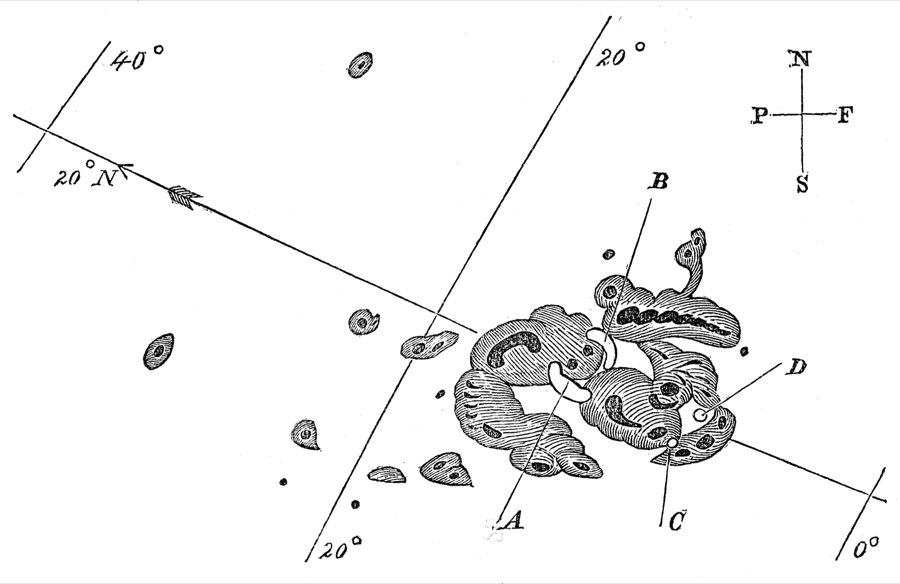
    An engraving of a cluster of shaded sunspots crossed by ruled lines of solar latitude. Four letters mark it: A and B on two bright crescents in the middle of the group, C and D on two small dots to the lower right.

    11:18

    1. This is Carrington's own figure, printed with his report. He wrote that the white light broke out at the places marked A and B, and that in five minutes the two patches travelled about 35,000 miles across the Sun's face.

      On the recordCarrington 1859

    2. C and D are usually read as the places where the last traces faded. We have not yet checked that against Carrington's own page, so the replay above is our illustration of the usual reading.

      Not yet tracedCarrington 1859

    Explanation2 September 1859

    A storm in Earth's magnetic field

    1. A geomagnetic storm is a major disturbance of Earth's magnetic surroundings, set off when energy from the Sun's outflow pours into near-Earth space. The strongest follow eruptions on the Sun.

      On the recordNOAA

    2. The storm of 2 September 1859 drove most magnetic instruments off their scales.

      On the recordOliveira 2020

    3. Storms like this drive electric currents through long conductors on the ground. Today NOAA warns about power grids and pipelines. In 1859 the long conductors were telegraph wires, and that is the standard explanation for what the operators saw.

      InterpretationNOAA, Boteler 2006

    4. The same storms light the aurora.

      On the recordNOAA, NASA 2014

    Document2 September 1859, Boston to Portland

    “Working with the aid of the aurora alone”

    Boston
    Please cut off your battery, and let us see if we cannot work with the auroral current alone.
    Portland
    I will do so. Will you do the same?
    Boston
    I have already done so.
    Boston
    We are working with the aid of the aurora alone. How do you receive my writing?
    Portland
    Very well indeed
    Portland
    much better than when the batteries were on; the current is steadier and more reliable.
    Portland
    Suppose we continue to work so until the aurora subsides?
    Boston
    Agreed.
    Boston
    Are you ready for business?
    Portland
    Yes; go ahead.
    1. On the forenoon of 2 September, between half past eight and eleven, two operators on the American Telegraph Company's line had this exchange. They worked that way for more than two hours, until the aurora faded.

      Reported at the timePrescott 1860

    2. It was the second storm in a week. On 28 August a Washington operator, Frederick W. Royce, brushed a ground wire with his forehead and “received a very severe electric shock, which stunned me for an instant.”

      Reported at the timePrescott 1860, Green 2006

    3. You may have read this conversation in different words. Another version circulates online, credited to a Boston newspaper. We could not find that newspaper, so we quote the 1860 book.

      Not yet tracedPrescott 1860

    Place28 August to 2 September 1859

    Dawn at the wrong hour

    1. Auroras belong near the poles. This one was seen as far south as Cuba.

      On the recordNASA 2014

    2. There were two great displays. The first began on 28 August, the second on 2 September.

      On the recordGreen 2006

    3. The best-loved story of the week: gold miners in the Rocky Mountains, woken by the glow, got up and started breakfast.

      Not yet tracedOdenwald 2008 (not read)

    Your turnChecked for this page, November 2026

    Three stories from that week

    One of these was printed within a year. One was a scientific claim that later evidence undercut. One is a modern retelling we have not traced back to 1859.

    Which one is the untraced retelling?

    • Printed in an 1860 telegraph manual, with the operators' own words.

      Reported at the timePrescott 1860

    • It appears in modern retellings. We have not read an 1859 report of it, so it keeps this label until we do.

      Not yet tracedOdenwald 2008 (not read)

    • An earlier ice core seemed to show it. A 2012 study of 14 cores found an 1859 spike in only one, and tied most such spikes to wildfire smoke.

      Sources differWolff 2012

    The best story is often the hardest to source. Fiki keeps the label on.

    ConsequenceMarch 1989 and 23 July 2012

    The one that missed

    1. In March 1989 a geomagnetic storm knocked out power across Quebec.

      On the recordNASA 2014

    2. On 23 July 2012 a powerful eruption tore through Earth's orbit. Earth was not there. A spacecraft, STEREO-A, was. “If the eruption had occurred only one week earlier, Earth would have been in the line of fire,” said Daniel Baker of the University of Colorado.

      On the recordNASA 2014

    3. How often? The physicist Pete Riley put the chance of a Carrington-class storm striking Earth within ten years at 12 percent.

      InterpretationNASA 2014

    4. How strong was 1859 itself? The storm drove most magnetic instruments off their scales. Only the station at Colaba, in Bombay, kept a full record.

      Still openOliveira 2020

    EvidenceAD 774 and AD 993: separate from 1859

    A signal in the rings

    1. In 2012 Fusa Miyake and colleagues measured carbon-14 in the rings of Japanese cedars and found a sudden jump in AD 774–775.

      On the recordMiyake 2012

    2. A year later the same group reported a second jump, in AD 993–994. The Newfoundland study places it in 993, the year used from here on.

      On the recordMiyake 2013, Kuitems 2022

    3. What made them? Energetic particles from space striking the upper air, which is how carbon-14 is made. A 2015 study of ice cores concludes that the particles most likely came from extreme outbursts on the Sun, and finds a comet hard to square with the evidence.

      InterpretationMekhaldi 2015, Miyake 2013

    4. These are not the 1859 storm. They are separate events, 1,085 and 866 years earlier, and of a different kind. The same 2015 study notes that the 1859 flare produced no notable rise in radiocarbon.

      On the recordMekhaldi 2015

    5. The jump shows up in trees around the globe in the same year. Any piece of wood that holds it carries a date stamp.

      On the recordKuitems 2022, Mekhaldi 2015

    DiscoveryL'Anse aux Meadows, Newfoundland

    A felled tree, and an exact year

    1. At L'Anse aux Meadows in Newfoundland, three pieces of wood had been cut with metal tools. Such tools “were not manufactured by the Indigenous inhabitants of the area at the time.”

      On the recordKuitems 2022

    2. Each piece holds the AD 993 jump. Counting the rings from it out to the bark edge gives the year the trees came down. In the paper's numbering the 993 ring sits 28 rings in from the bark, and 993 plus 28 is 1021. All three pieces agree.

      On the recordKuitems 2022

    3. The authors call it “the only secure calendar date for the presence of Europeans across the Atlantic” before Columbus, whose crossing came 471 years later, and “the first known point at which humans encircled the globe.”

      On the recordKuitems 2022

    4. How long the Norse stayed, and how often they came, is unsettled. The sagas disagree, and the authors leave how 1021 fits the wider story as “a matter for future research.”

      Still openKuitems 2022

    See what you found

    The launch list

    Be here when the door opens.

    We will write when Fiki opens.

    Email us for an invitation

    The sign-up list is not open yet, and this page collects nothing. The button opens your own email app with a message to hello@fiki.life. Nothing is sent unless you send it, and you are not added to any automatic list.

    What Fiki is

    A place to follow your curiosity, with the evidence in view.

    Fiki is being built now. The thread above is a small, hand-made sample of how it works. Four words cover it.

    Tick
    One thing that happened, with the evidence it rests on. Every card in the thread is a Tick.
    Rabbit Hole
    The path you make when one question leads to the next.
    Timeline
    The same Ticks set in order of time, so a longer story can be read from its start.
    Atlas
    The whole map. Every Tick, Rabbit Hole and Timeline, joined.

    Also on the way

    • Roots does the same for your own family, privately.
    • August is an AI guide to what is known and what is not. It helps you explore; it does not decide what is true.
    • Sparks are what people add: finds, questions, disagreements.

    Every claim on Fiki carries a label saying how well it is supported. See the six labels and every source behind this page.

    The Question Vault

    What have you always wondered about?

    A mystery from history. An ancestor nobody talks about. Why everyone suddenly believed something. Two events that seem connected.

    Leave it here. This is separate from the launch list: you do not need to give an email.

    We mean to read every question. We cannot promise to investigate or answer each one.

    The vault is not open yet. We are still proving that what you send is stored safely. Until that is done, this page collects nothing.

    For archives, libraries and data providers

    Evidence is the authority here.

    Fiki cites what it reads, says what it has not read, and keeps claims, interpretations and open questions visibly apart. If you look after records or run a research API, this page is for you.

    Read how Fiki uses sources